
About isotopes
Atoms of the same element can have different numbers of neutrons — these are called isotopes. Think of them like siblings: same family (the element), slightly different traits (mass and stability related to number of neutrons). Isotopes have been used for medical and industrial purposes since the 1940s.
About isotopes production
History of isotope production at the Bruce Power site
Isotopes at Bruce Power are produced as part of our process of safely creating electricity (cobalt-60) and also through a dedicated Isotope Production System (lutetium-177). Isotopes can also be produced on research reactors or in specialized facilities designed for medical and industrial applications. Bruce Power’s approach leverages the reliability of our “always on” CANDU reactors to produce medical isotopes dependably and with great capacity to scale, helping meet growing global demand while supporting innovation in cancer treatment and sterilization technologies.
Since 1986, the Bruce Power site on SON Territory has been a consistent, reliable source of cobalt-60, which is essential to the medical community.
The isotope production system
Since 2019, Bruce Power and Saugeen Ojibway Nation (SON) have collaborated to secure funding that would allow SON allow SON to invest in the isotope production system (the “IPS”) that irradiates isotopes with shorter half-lives that require more frequent harvesting such as lutetium-177.
Beginning in 2022 when the first production line for lutetium-177 installed on Unit 7 was operational, isotope revenues have provided SON with a revenue stream supporting community priorities.
In 2023, the partnership expanded with $9.1M in funding from the Strategic Innovation Fund. This funding helped support the addition of a second production line for lutetium-177 on Unit 7 in 2024. By 2027, a second IPS will be installed on Unit 6, building even greater capacity.
Both lutetium-177 and cobalt-60 production leverage existing site infrastructure and minimize the creation of new long-term waste streams.
About the Isotope Production System (IPS)
The Isotope Production System is the first of its kind to produce lutetium-177 on a commercial reactor. Additional partners include Isogen, a joint initiative between Kinectrics, which designed, manufactured, and installed the Isotope Production System at Bruce Power and supports ongoing lutetium-177 production before and after irradiation, and ITM, a radiopharmaceutical company based in Munich who further prepare the lutetium-177 and then deliver it globally. The IPS is built primarily upon existing reactor infrastructure.
Currently the IPS only produces non-carrier-added lutetium-177, which in Canada is primarily used for prostrate cancer treatment. More isotopes are being explored for potential production.
Unlike cobalt-60, which is only harvested during outages, isotopes produced on the isotope production system can be harvested as often as twice per week, depending on resourcing.
About the isotopes
Lutetium-177
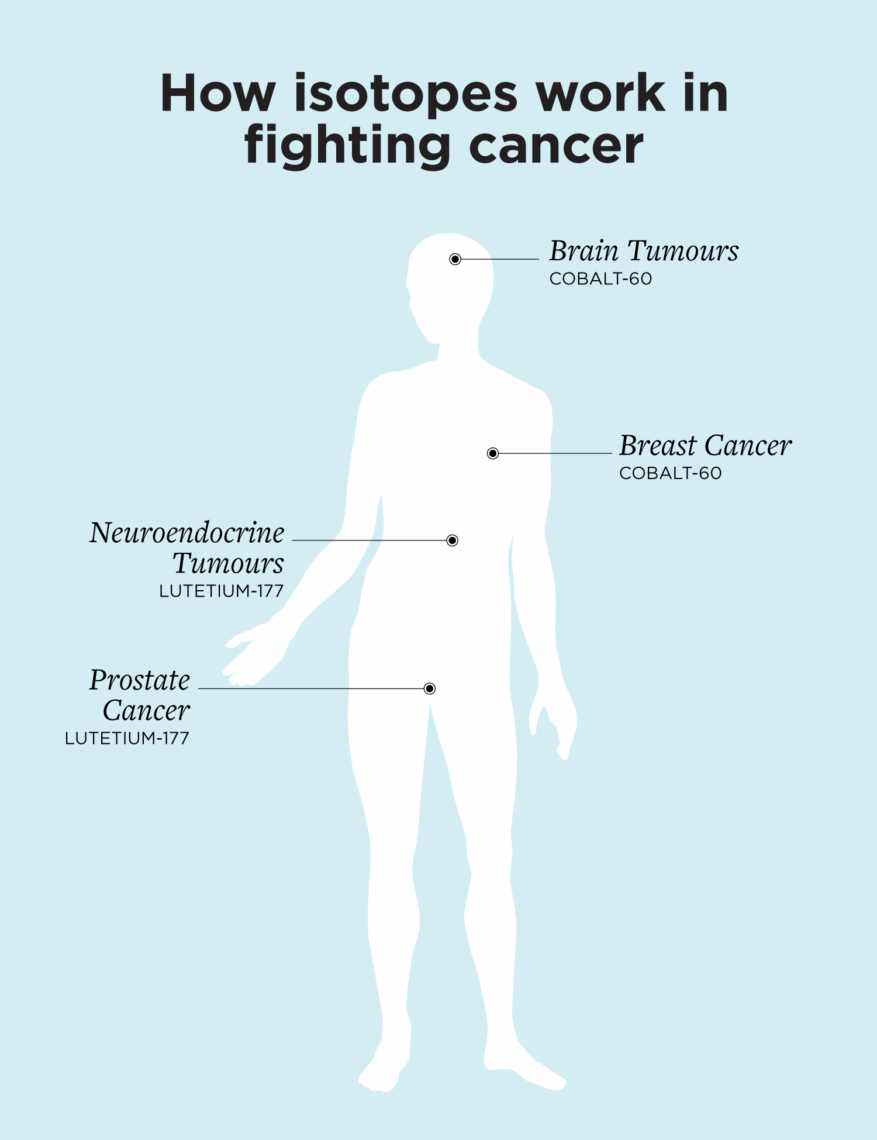
Lutetium-177 is a short-lived medical isotope with a half-life of 6.7 days. Lutetium-177 is used in precision oncology for targeted therapy of a growing number of cancers.
How does lutetium-177 treat cancer?
The lutetium-177 produced in the IPS is attached to a targeting molecule in the process of becoming a radiopharmaceutical treatment. This allows it to target cancer cells and spares healthy tissues, offering a better alternative than standard treatments such as chemotherapy and global radiation for those seeking conventional cancer treatment.
Lutetium-177 has also been approved for use to treat neuroendrocrine tumours (NETs), specifically gastroenteropancreatic neuroendocrine tumours (GEP-NETs). Currently, our non-carrier added lutetium-177 is not yet used to treat NETs.
Lutetium-177 treatments are publicly funded in Ontario, for eligible advanced prostate cancer patients.
What else is lutetium-177 used for?
Lutetium-177 is also used widely in research. As of 2025, Lutetium-177 is currently being investigated in clinical trials for treatment of some cancers including but not limited to:
- Glioblastoma, a fast-growing brain tumour
- Small cell lung cancer
- Merkel cell carcinoma, an aggressive form of skin cancer
- Meningioma, a type of tumour formed near the brain
- Central Nervous System Tumours, which can be both brain or spinal cord tumours
- Pancreatic tumours
Cobalt-60
Cobalt-60 is an isotope used to sterilize over 30 per cent of the world’s single-use medical equipment such as surgical masks, surgical gowns, syringes and gloves. Cobalt-60 sterilizes through gamma irradiation more quickly and in larger volumes than other forms of sterilization.
How cobalt-60 is made
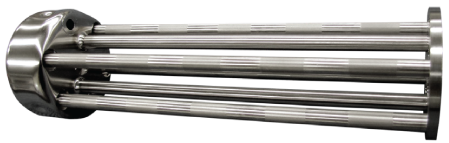
Cobalt-60 does not require the Isotope Production System that was built to produce lutetium-177. Instead, adjustor rods containing cobalt-59 are used as part of Bruce Power’s safety systems. These rods are irradiated over 24-36 months in the reactor core and harvested during planned outages.
How does Cobalt-60 treat cancer?
Cobalt-60 can also be used to treat brain cancer and other abnormalities in the brain. Leksell Gamma Knife® radiosurgery is a type of radiation therapy used to treat tumours and other abnormalities in the brain.
In Gamma Knife® radiosurgery, specialized equipment focuses close to 200 tiny beams of radiation on a tumour or other target. Although each beam has very little effect on the healthy tissue it passes through, a strong dose of radiation is delivered to the site where all the beams meet.
The GammaPod® is a medical device that treats early-stage breast cancer using a special type of radiation. It works with 36 rotating sources of cobalt-60 — a radioactive material that gives off strong gamma rays. Similar to the Gamma Knife®, the rays are aimed precisely at the tumour from different angles, which helps destroy cancer cells while protecting nearby healthy areas like the heart and lungs.
Manufacturer
Plant inserts pellets and slugs into adjusters, which are delivered to reactors.

Nuclear Reactors
Adjusters are installed in the reactor core where cobalt-59 is irradiated to become cobalt-60.
During a planned maintenance outage, it is harvested and stored in the secondary fuel bay.
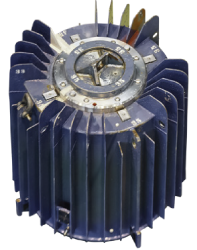
The cobalt-60 is removed from the fuel bay and shipped to the processing facility.

Isotope Processors
At the facility, the cobalt-60 is processed into sources for industrial or medical use.
Global Distribution
The sources are shipped globally.